NWA Interventional Pain Reopens in Rogers, Arkansas
There are few things more rewarding than returning to the work and community you love. After some time away to deal with pressing family matters out of state, I am excited to share that NWA Interventional Pain has reopened in Rogers, Arkansas. I am excited to be back home!
Northwest Arkansas has been home for many years, and the opportunity to once again care for patients in this community is something I truly value. While much has changed over the past few years, my commitment to providing compassionate, patient-centered pain management remains the same. In many ways, this reopening represents a fresh start with a new location, renewed energy, and an even stronger dedication to helping patients improve their quality of life.
As we begin this new chapter, I would like to share what makes this return so meaningful, what patients can expect from our practice, and how we are working to make high-quality interventional pain care more accessible than ever.
Coming Home to Rogers
There’s something different about caring for people in the same community where you live, shop, and work. That’s what practicing in Rogers has always meant to me. Over the past 18 years, I’ve had the privilege of treating patients throughout Northwest Arkansas for chronic and acute pain, and I’ve built real relationships along the way, not just with patients, but with the referring physicians, nurses, and specialists across the region who trust me with their patients’ care.
Being away from that, even temporarily, made me realize just how much this community means to me. I’ve missed the conversations in the exam room, the follow-up visits where someone tells me they finally slept through the night without pain, and the simple privilege of being trusted with something as personal as someone’s health.
Reopening here in Rogers isn’t just a business decision. It’s genuinely coming home.
A Fresh Start, Same Trusted Care
If you were a patient of mine before this move, I want to reassure you: this is the same practice, the same clinical philosophy, and the same commitment to your care, just in a new space. Your medical history and treatment records have transferred with us, and my team is ready to pick up right where we left off. For patients who are new to the practice, this fresh start is a good opportunity to begin with a truly comprehensive evaluation rather than jumping straight into treatment. Either way, my approach hasn’t changed one bit through this transition, only the walls around it.
Grateful for the Team Behind This Move
A reopening like this doesn’t happen because of one person, and I want to take a moment to recognize the team that made it possible. Moving a medical practice involves an enormous amount of behind-the-scenes work: securely transferring records, setting up new equipment, training on new workflows, and ensuring nothing falls through the cracks during the transition. My staff has worked incredibly hard to ensure that when patients walk through our doors, the only thing they notice is that everything simply works the way it always has.
Because we’re family-owned and operated, this team isn’t a rotating cast working under a corporate staffing model; many of the same familiar faces you’ve seen at previous visits are the same people who helped make this reopening happen. That continuity matters just as much to me as continuity in your medical care does.
Why I Got Into Pain Management
I didn’t set out to become a pain doctor by accident. After earning my degree in microbiology with high honors from the University of Florida, I pursued a dual MD/MBA at the University of South Florida, followed by an anesthesiology residency and a pain medicine fellowship at the University of Texas Southwestern. Along the way, I became dually board certified in both anesthesiology and pain medicine, a combination that a relatively small number of physicians nationally hold.
What drew me to this specialty was simple: chronic pain touches nearly every part of a person’s life, their sleep, their work, their relationships, their sense of who they are. Helping someone get even a portion of that back is some of the most meaningful work I know how to do. That’s the same reason I served for years as Medical Director of the Mercy Hospital Pain Clinic before eventually opening my own practice, so I could build the kind of patient experience I always believed pain care should be.
What Sets Independent, Family-Owned Care Apart
I want to be honest about something, because I think patients deserve to understand the difference between the care they receive at a practice like mine and the care that’s become increasingly common as more of medicine gets bought up by large corporate groups and private equity firms.
 Over the past several years, pain management has become an increasingly attractive target for corporate consolidation. A 2024 study published in JAMA Network Open, “Trends in Private Equity Acquisition of Pain Management Practices” by Bejarano, Eubanks, and Braun, found that private equity ownership of pain management practices grew sharply over the past decade, rising from just 0.4% of U.S. pain physicians in 2013 to 8.2% by 2023. That kind of ownership structure often comes paired with production-based compensation models, commonly measured in relative value units, or RVUs, that reward physicians for how many patients they see and how many procedures they perform rather than for the quality of time spent with each one. Under these kinds of arrangements, physicians are often expected to hit specific productivity targets, which can create real pressure to move quickly.
I’m not sharing this to criticize every doctor working within that system; many are excellent physicians doing their best within structures they didn’t choose. But I do think patients deserve to know that not every practice operates that way, and mine doesn’t. NWA Interventional Pain is family-owned and operated. I don’t answer to a corporate board, I don’t have a required daily patient quota, and no one is telling me how many minutes I’m allowed to spend with you. That independence is exactly what lets me practice medicine the way I believe it should be practiced.
This isn’t a new philosophy I’m adopting for the reopening. It’s the same reason I left a larger institutional setting years ago to open my own practice in the first place, because I wanted the freedom to build a patient experience around what’s actually best for the person in front of me, not around a productivity spreadsheet.
What a Visit With Me Actually Looks Like
When you come in for an appointment, I start with a genuinely thorough history and physical examination, not a rushed checklist. I want to understand your pain in your own words: when it started, what makes it better or worse, how it’s affecting your daily life, and what you’ve already tried. When imaging like an X-ray, MRI, or CT scan is warranted, I order it to get a complete picture before recommending treatment, rather than guessing.
From there, we sit down together and talk through your options, not just the interventional procedures I’m trained in, but conservative approaches like physical therapy, bracing, and medication management, and referrals to specialists like psychology or acupuncture when that’s genuinely the right next step for you. I explain the reasoning behind each recommendation, because I believe patients make better decisions about their own care when they actually understand it, not when they’re just told what to do.
This kind of visit takes time. It’s not something you can do in a tightly scheduled block designed to maximize how many patients move through the building in a day. It’s part of why, if you’ve been to see me before, you may remember that I don’t feel rushed, and you shouldn’t have to either.
Comprehensive, Individualized Treatment Options
 None of the medicine has changed with this move, only the address. I continue to treat the full range of conditions I always have, with neck pain and low back pain being two of the most common reasons patients come to see me, alongside sciatica, herniated discs, spinal stenosis, SI joint pain, failed back surgery syndrome, fibromyalgia, occipital neuralgia, and more.
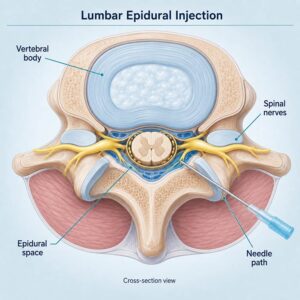
Treatment starts conservatively when appropriate: physical therapy, TENS units, bracing, home exercise plans, and medication management, and moves toward interventional options like epidural steroid injections, medial branch nerve blocks, facet joint injections, radiofrequency ablation, spinal cord stimulation, and targeted nerve blocks when a more direct approach is warranted.
I’m also known for using a smaller needle gauge during injection procedures, which many patients tell me makes a real difference in their comfort during treatment.
Every treatment plan I build is specific to the patient in front of me. What works well for one person’s back pain may not be the right starting point for someone else, and that kind of individualized care is only possible when a physician has the time and independence to actually practice that way.
Excited to Serve This Community Again
To every patient who has trusted me with their care over the years, and to every referring physician who has sent a patient my way because you knew they’d be genuinely taken care of, thank you. That trust is not something I take lightly, and it’s a huge part of why reopening here in Rogers feels like such an important moment for me personally.
A Note to My Referring Colleagues
I also want to speak directly to the physicians, nurse practitioners, and physician assistants across Northwest Arkansas who have trusted me with your patients over the years. That relationship matters enormously to me, and it’s built on the same principle as everything else in this post: genuine, thorough communication rather than a rushed handoff.
When you refer a patient to me, you’ll continue to receive detailed consult notes explaining my findings, my reasoning, and my treatment recommendations, not a generic template. If a patient’s case is complex or doesn’t fit neatly into a standard pathway, I’ll reach out directly rather than leaving you guessing. I’ve always believed that good referral relationships are built the same way good patient relationships are: through real communication and follow-through, not just paperwork. I’m looking forward to picking that partnership back up now that we’re settled into our new location.
I’m looking forward to reconnecting with familiar faces and meeting new patients throughout Northwest Arkansas who are ready for a different kind of pain care experience, one where you’re treated like a person with a story, not a number on a schedule.

Scheduling Your Appointment
Our office hours are Monday through Thursday from 7:30 a.m. to 5:00 p.m., and Friday from 7:30 a.m. to 11:00 a.m. To schedule your appointment, call us at (479) 413-4108 or email info@NWApain.com, and our staff will help find a date and time that works for you. Existing patients can access appointment history, billing, and medical records anytime through our patient portal.
If you are experiencing chronic neck pain or back pain and live near Rogers, Arkansas, now is a great time to schedule an appointment with Dr. Stephen Irwin as we welcome patients back to our new location. NWA Interventional Pain serves patients throughout Northwest Arkansas and the surrounding areas.
This blog post is intended for general educational purposes only and does not constitute medical advice. It is not a substitute for a professional diagnosis or treatment plan. Please consult Dr. Irwin or another qualified physician regarding your specific symptoms or condition before making any medical decisions. If you are experiencing a medical emergency, call 911 immediately.